

Table of Contents
A practical first-customer playbook for bootstrapped SaaS founders.
Getting your first paying customer is a major step, but one customer does not make a repeatable business.
The next challenge is turning an initial sale into a reliable stream of recurring revenue. You need to understand who is willing to pay, what they value, how to reach more people like them and what makes them continue using your product.
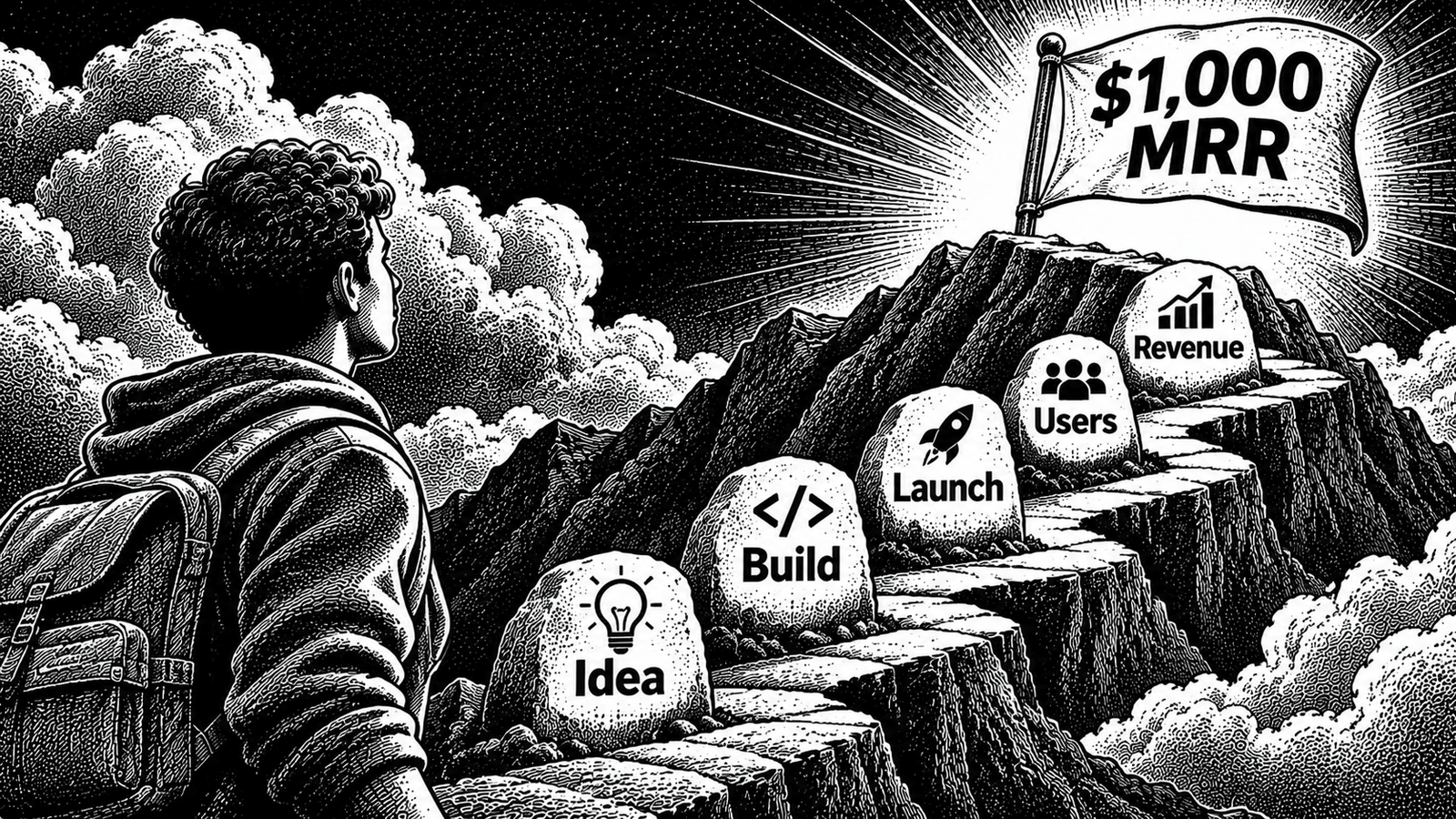
For a small SaaS business, $1000 in monthly recurring revenue (MRR) is a useful milestone. It gives you an actual revenue base to learn from, rather than relying only on signups, website traffic or positive feedback.
But reaching $1000 MRR is not a guaranteed sign of product-market fit or profitability. The quality of the customers, their continued usage and the economics of serving them matter just as much as the headline number.
This guide explains how to approach the milestone through founder-led sales, focused customer acquisition, pricing, onboarding and retention.
1. Understand what $1000 MRR actually means
Monthly recurring revenue is the monthly-normalised value of recurring subscriptions.
It is different from total cash collected during a month.
For example, suppose a customer purchases an annual subscription for $1,200. Its monthly-normalised recurring value is $100, not $1,200 MRR. Stripe also excludes trialling subscriptions from its MRR calculation and does not count taxes as revenue. Discounts and billing arrangements can affect the calculation, so use a consistent definition throughout your reporting.
Read Stripe’s explanation of MRR and ARR.
For this guide, the target is:
$1000 MRR from active recurring subscriptions.
It does not mean:
- $1000 in one-time setup fees.
- $1000 in total invoices generated during a month.
- $1000 in trial subscriptions.
- $1000 in profit after expenses.
- $1000 in guaranteed cash received every month.
MRR is a useful operating metric, but it is not the same as accounting revenue, profit or cash flow.
Before planning your target, decide how you will treat annual subscriptions, discounts, payment failures and cancellations. Billing platforms can apply different conventions. The important thing is to use one consistent method and understand what your dashboard includes.
2. Calculate how many customers you need
The first step is to make the revenue target concrete.
The basic calculation is:
Required paying customers = Target MRR ÷ Monthly recurring revenue per customer
Here are some illustrative pricing scenarios:
| Monthly price per customer | Customers needed | Resulting MRR |
|---|---|---|
| $29 | 35 | $1,015 |
| $49 | 21 | $1,029 |
| $99 | 11 | $1,089 |
| $199 | 6 | $1,194 |
The customer counts are rounded up to the next whole customer.
These are arithmetic examples, not recommended prices or market benchmarks.
The main lesson is that the number of customers you need depends on the price and value of your product.
A low-priced product may need more customers and a stronger distribution system. A higher-priced B2B product may need fewer customers, but usually requires stronger evidence of business value, trust and a buying process that supports the price.
Do not choose a price only to reduce the customer count
A $199 monthly subscription is not automatically easier to sell than a $29 subscription.
Ask:
- How expensive is the problem for the customer?
- How often does the problem occur?
- What does solving it save in time, money or effort?
- Who controls the purchasing decision?
- How much support does each account require?
- Can your product deliver enough value to justify the price?
Your price should reflect the value and buying context, not just the arithmetic needed to reach $1000.
For a more detailed pricing decision, build a separate pricing strategy around customer value, costs and willingness to pay. Do not use a revenue milestone as the only reason to raise prices.
3. Start with one specific type of customer
A common early mistake is trying to sell to everyone.
A broad product description such as “project management software for businesses” does not tell you who to approach first.
Instead, narrow the first customer group.
For example, a hypothetical project-management product might initially focus on:
- Small web design agencies.
- Independent consultants managing multiple clients.
- Small software development teams.
- Marketing agencies coordinating client approvals.
These groups may have different workflows, budgets and reasons to buy. They should not automatically be treated as one audience.
Choose a group where you can understand the problem and reach potential buyers directly.
Write a simple customer profile:
| Question | What to define |
|---|---|
| Customer | Who is likely to pay? |
| Problem | What recurring issue are they experiencing? |
| Current solution | How do they handle it today? |
| Cost of the problem | What does it cost in time, money or missed work? |
| Buying decision | Who can approve the purchase? |
| Trigger | What makes solving the problem urgent now? |
This profile is not a permanent description of your entire market. It is a starting point for finding your first customers.
If you discover that the people who use the product are different from the people who pay for it, record both roles. This matters particularly for B2B SaaS.
4. Find your first paying customers manually
Do not assume that publishing a landing page will automatically bring customers.
In the early stage, the founder usually needs to find potential buyers and start conversations directly.
Paul Graham’s essay Do Things That Don’t Scale describes why early startups often recruit users manually instead of waiting for growth to happen on its own.
Y Combinator gives similar advice in YC’s Essential Startup Advice: founders should acquire early customers, learn directly from them and avoid building expensive systems before they understand what works.
Here are practical places to start.
Your existing network
Start with people who genuinely know the audience you want to serve.
That may include former colleagues, professional contacts, founders, business owners or people who can introduce you to a relevant buyer.
Do not expect friends and family to become customers simply because they know you. Ask for relevant introductions rather than pressuring people to buy.
Relevant communities
Find places where your potential customers already discuss their work.
These might include industry groups, professional communities, technical forums or relevant subreddits.
Look for people discussing a problem your product solves. Contribute useful answers and share your product only when it is relevant and permitted by the community.
Direct conversations with target customers
Identify businesses or individuals that match your customer profile.
Research them individually. Understand their workflow before contacting them.
A useful first conversation is about the problem, not a generic product pitch.
Existing tools and service providers
Look for complementary businesses that already work with your target customers.
For example, a SaaS product for agencies might be relevant to consultants who help agencies improve their operations.
A genuine partnership can create access to an audience that would otherwise take time to reach.
Your own content and product presence
Publish useful information around the customer’s problem.
A practical tutorial, comparison or resource can help a potential buyer discover your product and understand your approach.
This is a longer-term acquisition route. It should support, not replace, direct customer learning during the early stage.
5. Turn conversations into paid customers
Getting someone to agree that your idea sounds interesting is not the same as getting someone to pay.
Your job is to understand whether the problem is important enough for the person to make a purchasing decision.
During a conversation, ask questions such as:
- How do you handle this task today?
- When did you last experience this problem?
- What happens when the task goes wrong?
- Have you tried another tool or workaround?
- Who else is involved in solving this problem?
- What would make you consider paying for a better solution?
Avoid leading questions such as:
Would you use an app that solves this?
People may say yes because the idea sounds appealing, even when they have no intention of buying.
Instead, learn about their actual behaviour, existing spending and willingness to change.
Demonstrate the product around their workflow
Do not show every feature.
Show how the product handles the task they described.
A useful demonstration should include:
- The customer’s current problem.
- The relevant product workflow.
- The outcome the customer can verify.
- Any limitations or prerequisites.
- The price and next step.
Be clear about what works today. Do not promise features that are not available.
Ask for a real purchase decision
At the right point, explain the paid offer.
Depending on your product, that could be a regular subscription or a clearly scoped paid pilot.
A paid pilot should define what is included, how long it lasts, what the customer receives and what happens afterwards. Avoid open-ended custom work that cannot be delivered profitably.
A real purchase decision gives you stronger evidence than a signup or a verbal compliment.
6. Make the first few customers successful
Once someone pays, the work is not finished.
A customer who pays once and then stops using the product does not create a healthy recurring-revenue base.
Help early customers reach the main outcome they purchased the product for.
You can do this manually:
- Help them complete the initial setup.
- Configure the product where appropriate.
- Show them the most relevant workflow.
- Check whether they reached the expected result.
- Ask where they became confused.
- Resolve genuine onboarding problems.
This is sometimes called high-touch onboarding. It can be useful when the customer count is small and you are still learning which parts of the process need improvement.
Be transparent about any manual work you perform behind the scenes. Do not pretend a service is automated when it is actually being completed manually.
Learn from every customer
Maintain a simple customer record:
| Information | What to record |
|---|---|
| Customer type | Industry, role or business type |
| Main problem | Why they considered buying |
| Purchase reason | What convinced them to pay |
| First useful result | What they successfully completed |
| Objection | What almost stopped the purchase |
| Support request | What they needed help with |
| Retention signal | Whether they continue using the product |
After several customers, compare the records.
Look for repeated problems and repeated reasons for buying.
If each customer requires a completely different product, setup and sales explanation, you may not yet have a repeatable customer segment.
7. Move from one customer to a repeatable sales process
The first few customers often come from manual work.
That is normal at this stage. You are still learning which customer is a good fit, what message works and how the product should be introduced.
But manual acquisition should produce learning, not become a permanent collection of unrelated tasks.
After each successful sale, ask:
- Where did the customer come from?
- What problem made them interested?
- What did they understand immediately?
- What required additional explanation?
- What made them trust the product?
- What delayed the purchase?
- What can be repeated with the next similar customer?
Use those answers to refine your process.
Create a simple sales process
A lightweight process might look like this:
| Stage | Action | Record |
|---|---|---|
| Identify | Find a business matching your target profile | Customer fit |
| Research | Understand its workflow and likely problem | Evidence of relevance |
| Contact | Start an individual, relevant conversation | Response |
| Discover | Understand the current workaround and impact | Problem evidence |
| Demonstrate | Show the relevant product workflow | Questions and objections |
| Offer | Explain the paid plan or scoped pilot | Purchase decision |
| Onboard | Help the customer reach value | Activation |
| Follow up | Check usage and resolve blockers | Retention signal |
You do not need an expensive CRM to manage this early process. A simple spreadsheet can be enough.
For cold email specifically, keep outreach relevant and compliant with the laws that apply to you and your recipients. The planned IndieOS guide on compliant founder outreach will cover those mechanics in greater depth.
8. Keep customers before chasing more signups
MRR can grow when you acquire customers, but it can also shrink when existing customers cancel or downgrade.
Imagine adding new subscriptions every month while losing an equivalent amount of recurring revenue from cancellations.
Your customer count may look active, but your MRR could remain flat.
Track what happens to recurring revenue, not just how many new people register.
Common MRR movements include:
| Movement | Meaning |
|---|---|
| New MRR | Recurring revenue from new paying customers |
| Expansion MRR | Additional recurring revenue from existing customers |
| Reactivation MRR | Recurring revenue from customers who return after cancelling |
| Contraction MRR | Revenue lost when customers downgrade or reduce subscriptions |
| Churned MRR | Revenue lost when customers cancel |
These categories are used in subscription analytics systems such as ChartMogul. See its MRR movements documentation.
The basic calculation is:
Ending MRR = Starting MRR + New MRR + Expansion MRR + Reactivation MRR − Contraction MRR − Churned MRR
This tells you why acquiring customers is only part of the job.
If people cancel because the product does not solve the problem, more marketing may simply send more customers into the same experience.
Investigate cancellation reasons, product usage, onboarding friction and support requests before increasing acquisition activity.
9. Know when to stop doing everything manually
Manual work helps you understand customers, but it eventually becomes a constraint.
The goal is not to automate everything as soon as possible. The goal is to automate processes that have become sufficiently repeatable.
Consider automating a task when:
- You have performed it several times.
- The required steps are broadly consistent.
- You understand the common exceptions.
- Automating it will save meaningful time.
- Automation will not make the customer experience worse.
For example, you may initially onboard every customer personally. After observing the same setup process repeatedly, you can create a guided onboarding flow.
You may initially answer the same support questions individually. Once patterns emerge, you can create documentation or in-product guidance.
You may initially research every prospect manually. Once the ideal customer profile becomes clearer, you can make that research process more efficient.
Keep direct customer conversations even as you automate repetitive work. You still need to understand why people buy, use and leave your product.
Paul Graham’s Do Things That Don’t Scale is useful here: manual acquisition is a way to learn and get the business moving, not a requirement to operate manually forever.
10. Work through the $1000 MRR milestone
The path to $1000 MRR should be managed as a sequence of learning milestones.
Milestone 1: Get the first paying customer
Your first goal is to establish that someone will pay for the product.
Focus on:
- One specific customer group.
- One clear problem.
- One understandable paid offer.
- Direct conversations.
- A successful first-use experience.
Do not spend months building a large sales system before you have evidence that the offer works.
Milestone 2: Get a small group of similar customers
Once one customer pays, find more people with a similar problem.
Compare the reasons they bought.
If the same value proposition works repeatedly, you are learning something about the customer segment and the product’s positioning.
If every sale requires a different explanation or custom feature, investigate why before increasing volume.
Milestone 3: Standardise the offer and onboarding
As more customers use the product:
- Make pricing easier to understand.
- Clarify what each plan includes.
- Improve the first-use experience.
- Document repeated setup steps.
- Reduce avoidable support work.
- Record cancellation and downgrade reasons.
The purpose is to make the product easier to buy and use without removing the direct feedback loop.
Milestone 4: Close the remaining MRR gap
At this stage, calculate the gap between current MRR and the target.
Do not use total signups as a substitute for recurring revenue.
Identify whether the gap is best addressed through:
- More customers on the existing plan.
- A better-fit customer segment.
- A justified higher-value plan.
- Expansion from existing customers.
- Recovering customers who cancelled for fixable reasons.
Choose the route based on customer evidence and unit economics, not simply the largest possible price.
11. Use an MRR bridge to plan the remaining revenue
A simple MRR bridge helps you see how much new recurring revenue is actually needed.
The formula is:
New MRR required = Target MRR − Starting MRR − Expansion MRR − Reactivation MRR + Contraction MRR + Churned MRR
Consider this hypothetical example:
| Item | Amount |
|---|---|
| Starting MRR | $650 |
| Target MRR | $1000 |
| Expected expansion MRR | $25 |
| Expected reactivation MRR | $0 |
| Expected contraction MRR | $15 |
| Expected churned MRR | $35 |
The new MRR required is:
$1000 − $650 − $25 − $0 + $15 + $35 = $375
The ending MRR would be:
$650 + $375 + $25 − $15 − $35 = $1000
The example is illustrative. It is not a forecast or a report of actual SaaS results.
The useful point is that the amount of new revenue needed depends on what happens to your existing subscriptions. If customers downgrade or cancel, you need to replace that lost recurring revenue as well as close the original gap.
Copyable MRR planning sheet
| Field | Your value |
|---|---|
| Current MRR | Enter actual amount |
| Target MRR | $1000 |
| Expansion MRR expected | Enter estimate |
| Reactivation MRR expected | Enter estimate |
| Contraction MRR expected | Enter estimate |
| Churned MRR expected | Enter estimate |
| New MRR required | Calculate using the formula above |
| Average monthly revenue per customer | Enter actual amount |
| Approximate new customers required | New MRR required ÷ monthly revenue per customer, rounded up |
Update the sheet when subscription status, pricing or customer behaviour changes. Use actual billing data where possible.
12. Understand what $1000 MRR does not prove
Reaching $1000 MRR is a meaningful business milestone, but it is not the final measure of success.
It does not automatically prove:
- Your product has strong product-market fit.
- Customers will continue paying.
- Your business is profitable.
- Acquisition costs are sustainable.
- Your revenue is diversified.
- You can stop talking to customers.
Ten customers paying $100 each create a different risk profile from one customer paying $1000.
A business relying on one large account could lose most of its MRR if that customer cancels. A business with many smaller accounts may have different support and acquisition costs.
You should also understand how much it costs to serve each customer. Hosting, infrastructure, support, payment processing, AI usage, refunds and other operating costs affect how much money remains after revenue.
The next stage is not simply to increase the number on the dashboard. It is to build recurring revenue that customers continue to find worthwhile.
Common mistakes when trying to reach $1000 MRR
Building features instead of selling
Adding features feels productive, but it does not prove that anyone will buy. Spend time with potential customers and use their real problems to guide development.
Giving everyone a free account
Free users can provide useful feedback, but a large free-user count does not prove willingness to pay. Make the paid value and upgrade path clear.
Underpricing without understanding value
A low price may make the initial sale easier, but it can also require a much larger customer base. Check whether the price covers support and delivery costs.
Chasing too many customer types
Different customer groups may need different features and sales explanations. Start with a group you can serve well.
Ignoring cancellations
New sales can hide a weak retention problem. Track lost MRR and investigate why customers leave.
Automating too early
A complex CRM, marketing automation system or sales funnel is not the first requirement. Understand the sales process before automating it.
Confusing revenue with profit
MRR is a recurring-revenue measure. It does not subtract all operating expenses or tell you what the founder can take home.
Frequently asked questions
How many customers do I need to reach $1000 MRR?
It depends on your monthly recurring revenue per customer. At $49 per month, you need 21 customers to exceed $1000 MRR. At $99 per month, you need 11. At $199 per month, you need 6. These are arithmetic examples, not recommended price points.
How long does it take to reach $1000 MRR?
There is no reliable universal timeline. It depends on the problem, customer segment, price, sales cycle, distribution and retention. Treat $1000 MRR as a milestone to work towards, not a deadline that every SaaS founder should meet.
Should I focus on getting more customers or increasing prices?
Start by understanding why customers buy and what value they receive. More customers may be the right route when the product is affordable and easy to adopt. A higher price may make sense when the product delivers greater value to a specific buyer. Do not raise prices without a clear reason.
Should I offer a free trial?
A free trial can help customers understand the product before paying, especially when they can reach value quickly on their own. It is not suitable for every product. Track whether trial users reach the important activation step and whether they convert to paid subscriptions.
Is $1000 MRR enough to make a SaaS business profitable?
Not necessarily. Profit depends on operating expenses, payment costs, infrastructure, support, acquisition costs, taxes and other obligations. A product with $1000 MRR can be profitable or unprofitable depending on its cost structure.
What should I do after reaching $1000 MRR?
Review retention, customer concentration, acquisition sources, support workload and unit economics. Find out which customer segment values the product most and which acquisition process is repeatable. Then decide whether to improve retention, increase expansion revenue or acquire more customers.
Sources and further reading
- Stripe: Understanding Monthly Recurring Revenue and Annual Recurring Revenue
- Stripe: Calculating Monthly Recurring Revenue in Billing
- Stripe: What Is Monthly Recurring Revenue?
- Y Combinator: YC’s Essential Startup Advice
- Paul Graham: Do Things That Don’t Scale
- ChartMogul: Understanding MRR Movements
MRR definitions and platform documentation checked on 1 November 2026. Recheck billing conventions against the current configuration of your own payment system.

[…] a broader customer-acquisition perspective, connect your Reddit activity to the fundamentals in How to Get to $1,000 MRR. The point is not to maximise visits. It is to learn whether the conversations are bringing people […]