

Table of Contents
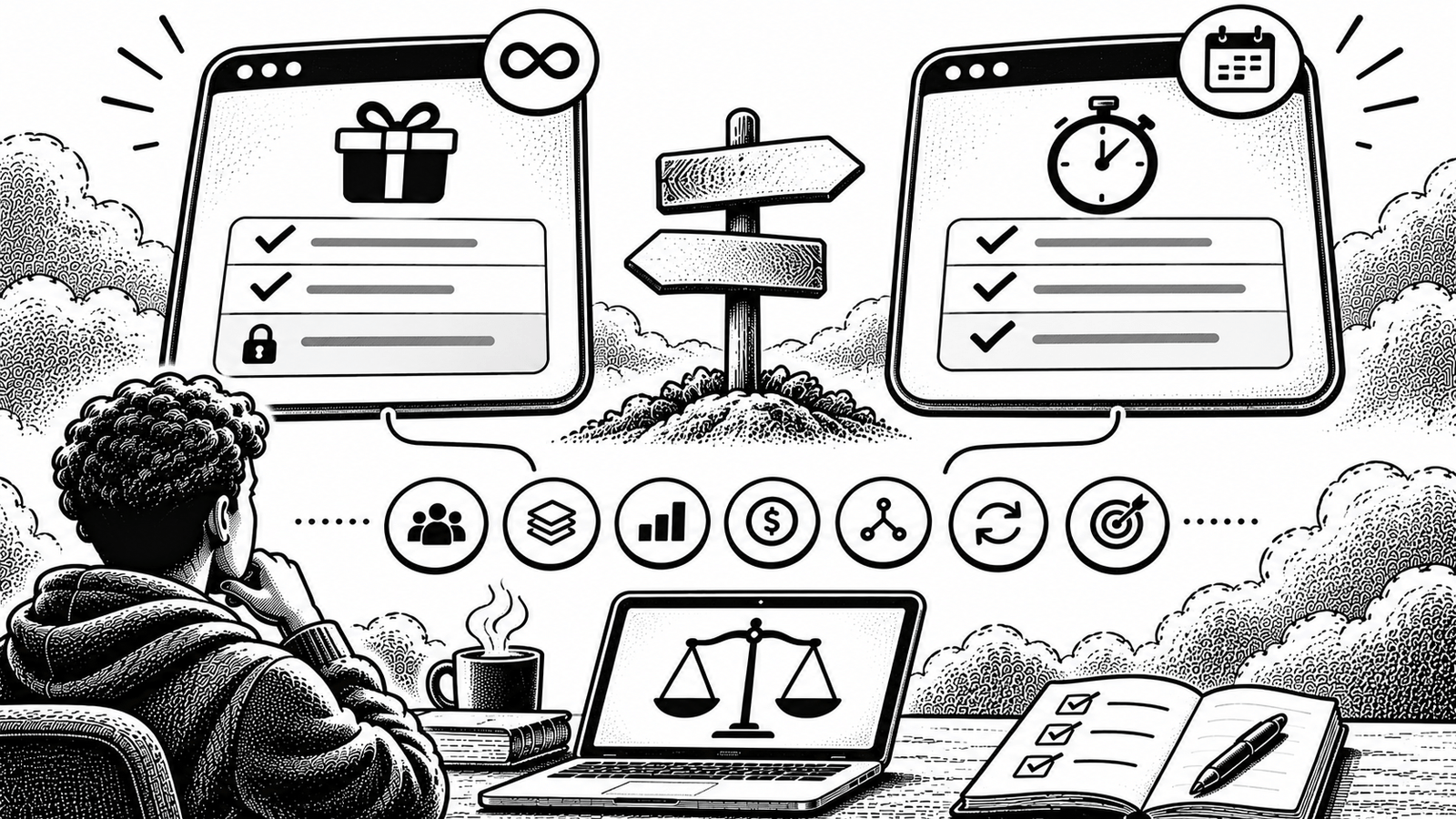
A free plan can bring people into your product without asking them to make a purchase. A free trial can give potential customers a limited period to experience the product before paying. Both remove some of the friction involved in buying software, but they create very different customer journeys.
The freemium vs free trial decision is not simply about which model attracts more signups. It is about how customers experience value, how much it costs to serve them, how quickly they decide to pay and how your product can support long-term revenue.
There is no universal winner. A product that creates value through repeated use may benefit from a permanent free tier. A product that solves a specific problem within a short evaluation period may be better suited to a free trial.
This guide gives you a practical way to choose between them, measure the results and avoid copying a model just because another SaaS company uses it.
Freemium vs Free Trial: What Is the Difference?
The main difference is how free access is limited.
Freemium gives users a permanently free version of the product, usually with restrictions on usage, features, capacity or collaboration. Users can continue using the free version without a countdown. They pay when they need capabilities available in a higher plan.
A free trial gives users access for a limited period. The access often includes the core paid experience, although the product may still restrict certain features, usage or seats. When the trial ends, the user must pay, lose access to trial features or move to another available plan.
Stripe describes freemium as a free entry-level product with paid upgrades for more features, usage or control. Paddle’s subscription trial documentation explains how time-limited product access can be configured and managed.
| Comparison | Freemium | Free trial |
|---|---|---|
| Access period | Continues indefinitely | Ends after a defined period |
| Product access | Permanently limited version | Often broader access to paid features |
| Signup friction | Usually low | Depends on signup and payment requirements |
| Main upgrade trigger | Usage, feature or capacity limits | Trial ending or continued access being needed |
| Cost exposure | Can continue for as long as the user remains free | Usually limited by the trial period |
| Customer decision | Can happen gradually | Often happens within an evaluation window |
| Main business challenge | Converting enough free users while controlling costs | Helping enough trial users reach value before expiry |
Neither model guarantees a better conversion rate. The right choice depends on what your product does and how customers buy it.
What Does the 2026 SaaS Conversion Research Tell Us?
A useful piece of recent research comes from the 2026 SaaS Conversion Report by ChartMogul and ProductLed.
The research surveyed 200 B2B software products in January 2026. Some of its reported findings were:
- 57% of surveyed products used a free trial as their primary entry point for new customers.
- 26% used freemium as their primary entry point.
- A 14-day trial was the most common trial duration, used by 62% of products.
- The median free-to-paid conversion rate across the sample was 8%.
- Free trials showed slightly higher free-to-paid conversion, but this advantage disappeared when signup rates were included.
The last finding matters most.
A model can convert a higher percentage of signups while producing fewer paying customers from the original website traffic. A founder who looks only at trial-to-paid conversion can therefore reach the wrong conclusion.
There are important limitations. The survey collected responses through Typeform and distributed them through email, Slack and social channels. Its typical respondent was a larger B2B software business than many early-stage indie SaaS products. The survey also asked respondents to estimate their conversion rates. Its 8% median should not be treated as a universal target for a new product.
Read the original ChartMogul SaaS Conversion Report for its findings and methodology.
The lesson is not that free trials are better because more companies use them. It is that conversion must be measured across the full customer journey, including people who never sign up.
When Does Freemium Make More Sense?
Freemium makes sense when a useful version of your product can continue serving customers without creating unsustainable costs.
The free version should be a real product, not a nearly empty demonstration. A user should be able to complete a meaningful task without immediately being forced to upgrade.
There are several conditions that make freemium worth considering.
1. Your product creates value through repeated use
Some products become more useful as customers continue using them. A user may return every day, build a library of information, create projects or gradually involve more team members.
A countdown timer can interfere with this process. Customers might need several usage cycles before understanding the product’s value.
A permanent free tier gives them room to build a habit and discover when a paid capability becomes necessary.
2. Free users have manageable serving costs
Every free account still has a cost.
Depending on your product, you might pay for:
- Server usage and database storage.
- AI model calls and token consumption.
- File processing and bandwidth.
- Email and notification services.
- Customer support.
- Third-party APIs and integrations.
A free plan can become expensive when every active account creates significant variable costs.
Stripe’s freemium pricing guide discusses the infrastructure, support and product costs associated with serving non-paying users.
Before offering permanent free access, estimate the cost of serving an active free account. Then check whether the expected upgrade revenue, referrals or other business value can justify that cost.
This is particularly important for AI SaaS products where usage can create a direct cost for every request.
3. There is a natural upgrade trigger
Freemium needs a meaningful reason to upgrade.
A free user might reach a project limit, need more storage, invite additional team members or require advanced automation.
These are natural upgrade moments because the user has already experienced the product’s value.
Possible freemium boundaries include:
| Free plan | Paid plan |
|---|---|
| Limited projects | More projects |
| Limited monthly usage | Higher usage allowance |
| Basic reports | Advanced analytics |
| Individual workspace | Team collaboration |
| Basic integrations | Advanced integrations |
| Standard processing | Faster or higher-capacity processing |
The distinction should be clear. The free version must solve a real problem, while the paid version should provide a reasonable next step.
Do not put essential functionality behind a paywall simply to force upgrades. When the free version cannot deliver its promised result, users may leave instead.
4. Your product benefits from sharing or distribution
Some products become more valuable when users share their work, collaborate or invite other people.
A permanent free tier can help these behaviours develop without requiring every new user to make a purchase decision immediately.
However, do not assume that your product is viral just because it has a free plan. Track actual invitations, referrals, shared outputs and new users generated by existing users.
Freemium is stronger when free usage contributes to distribution or creates a meaningful long-term upgrade opportunity.
When Does a Free Trial Make More Sense?
A free trial can work better when customers can evaluate the product within a defined period and understand why continued access is worth paying for.
It is particularly useful when the paid product has a clear evaluation path.
1. Customers can experience the main value within a limited period
Consider a product that automates a report, converts files or performs a specific business task.
A potential customer may be able to understand the result after completing a small number of real tasks.
In this situation, a time-limited trial can offer enough access to evaluate the product without creating a permanent free user base.
A trial is less suitable when customers need weeks of accumulated data or team adoption before they can judge the value.
2. Limiting the product permanently would weaken the experience
Sometimes the feature that makes a product worth paying for is difficult to separate from its core value.
For example, a customer evaluating a complex analytics workflow may need access to the advanced reporting experience itself. A restricted free plan could prevent the customer from understanding what the paid product actually does.
A trial gives the customer a broader experience before making the purchase decision.
3. Your product has a clear buying event
Some customers arrive with a specific need and an existing intention to purchase.
They may be comparing tools, replacing an existing system or trying to solve a problem for an upcoming project.
A trial can provide a clear evaluation period and a defined point at which the customer must decide whether to continue.
For more complex software, a guided trial or paid pilot may be more appropriate than completely unrestricted self-service access.
4. You want to limit the duration of free usage
A trial places a time boundary on free access. This can help control the duration of free usage, although it does not eliminate abuse or guarantee payment.
It also creates an operational responsibility. Users must understand when the trial ends, what they will be charged and how to cancel or continue.
A trial that creates confusion about billing can damage trust even when the product itself is useful.
Card-Required vs Cardless Free Trials
A free trial is not a single signup experience. One important decision is whether customers must provide payment details when starting.
Card-required trial
Customers provide a payment method during signup. They are not charged during the free period, but the subscription may automatically begin billing when the trial ends, depending on its configured terms.
This approach can qualify customers who are more prepared to purchase. However, requiring payment details can discourage people who are not ready to commit.
Cardless trial
Customers start without providing payment details. They can experience the product before entering a payment method.
This reduces signup friction, but the business must create a clear process for converting interested users into paying customers before the trial expires.
Paddle’s trial documentation describes the differences between card-required and cardless trials. It notes that cardless trials can attract more signups, while conversion among those signups may be lower.
Paddle also documents paid trials, where a customer pays a reduced amount for the trial period before the regular subscription price applies. A paid trial is not the same as a free trial, so do not combine those results when comparing free access models.
The right signup experience depends on customer expectations, purchase readiness and the friction your audience will tolerate.
Important: Make trial duration, renewal date, recurring price and cancellation instructions easy to understand before a customer starts. For apps distributed through Google Play, follow its subscription transparency requirements, including disclosure of the trial period, subsequent price and automatic renewal terms.
Seven Checks to Choose the Right SaaS Model
Use these checks before deciding which model to implement.
| Decision question | Stronger freemium signal | Stronger trial signal |
|---|---|---|
| Does the product create value over repeated use? | Yes, value builds over time | No, value is mostly experienced in a short evaluation |
| Can customers benefit from a limited version? | Yes, the free tier solves a useful problem | No, restricting core features weakens the evaluation |
| How quickly can customers reach value? | Value needs repeated use or accumulated data | Value can be demonstrated within a defined period |
| What does each free user cost? | Low and predictable variable cost | High or more manageable with time-limited access |
| Does free usage help distribution? | Sharing, referrals or collaboration matter | Individual product evaluation is more important |
| Is there a natural upgrade trigger? | Usage, capacity, collaboration or advanced features | Continued access after the trial |
| How do customers make purchase decisions? | Gradual self-serve adoption | A defined buying or evaluation decision |
Do not simply count which column has more answers. Some factors matter much more than others for a particular product.
For example, a product with high ongoing AI costs should not offer an unlimited free plan just because it has a strong sharing mechanism. Similarly, a trial is not a good choice if customers cannot experience meaningful value before the trial ends.
An illustrative example
Imagine two hypothetical SaaS products.
Product A: A team knowledge workspace
Users create documents, return to them regularly, invite teammates and gradually build a shared knowledge base.
A permanent free plan could make sense because the product becomes more useful as content and collaboration grow. Paid upgrades could introduce advanced permissions, higher storage or team administration.
Product B: A one-time data migration tool
A customer uploads data, runs a migration and checks the output. The main value can be evaluated during a specific project.
A time-limited trial may be more appropriate, provided the customer can complete a realistic migration within the evaluation period and the service cost is manageable.
These examples are illustrative, not customer case studies or measured conversion results. They show why product usage patterns matter more than copying another company’s pricing page.
Which Model Produces More Paying Customers Per Visitor?
This is the question founders should ask instead of looking only at free-to-paid conversion.
A trial can have a higher conversion rate after signup but a lower signup rate. Freemium can attract more users but convert a smaller percentage of them.
Compare the entire funnel.
1. Measure Signup Rate
Signup Rate (%) = (New Free Signups ÷ Eligible Unique Visitors) × 100
Use visitors who actually saw the relevant offer, not all traffic across unrelated website pages.
2. Measure Free-to-Paid Conversion
Free-to-Paid Conversion Rate (%) = (New Paying Customers ÷ Free Signups) × 100
Keep the cohort and measurement period consistent.
3. Measure Visitor-to-Paid Conversion
Visitor-to-Paid Conversion Rate (%) = (New Paying Customers ÷ Eligible Unique Visitors) × 100
For this calculation, define a consistent period and include relevant items such as refunds, payment fees, infrastructure, AI usage and variable support costs.
Do not use projected lifetime revenue as if it were cash already collected. Track actual retention and revenue separately.
A Freemium vs Free Trial Measurement Worksheet
Use the same worksheet for both models. This avoids choosing a winner based on a single attractive percentage.
| Measurement | Freemium cohort | Free trial cohort |
|---|---|---|
| Eligible unique visitors | ______ | ______ |
| New signups | ______ | ______ |
| Signup rate | ______ | ______ |
| Users reaching the activation event | ______ | ______ |
| New paying customers within the chosen period | ______ | ______ |
| Free-to-paid conversion | ______ | ______ |
| Visitor-to-paid conversion | ______ | ______ |
| Variable cost of free users or trial users | ______ | ______ |
| Revenue collected | ______ | ______ |
| Refunds and payment fees | ______ | ______ |
| Paid acquisition spend | ______ | ______ |
| Contribution per eligible visitor | ______ | ______ |
| Paying customers retained at 90 days | ______ | ______ |
Choose a measurement period suitable for your buying cycle. A short self-serve product may produce a purchase decision quickly, while a B2B product may need a longer evaluation period.
The ChartMogul 2026 survey asked respondents about conversion from leads or free signups to paying customers within six months. That is a useful reminder to define the measurement window before comparing results.
The worksheet is a decision aid, not a claim that a particular conversion rate is good for every business.
How to Test Both Models Without Misreading the Results
When you already have enough relevant traffic, a controlled experiment can help you compare the two approaches.
Step 1: Define your target customer
Use the same ideal customer profile for both groups.
Do not send one model to a high-intent audience and the other to broad, low-intent traffic. Otherwise, the result may reflect acquisition quality rather than the pricing model.
Step 2: Define the activation event
Decide what action proves that a customer has experienced the product’s core value.
Examples include creating a completed project, processing a successful file, inviting a teammate or generating a useful report.
This is more meaningful than counting account registrations alone.
Before making this decision, review what to test in a SaaS MVP. A pricing experiment cannot compensate for a product that has not demonstrated a useful outcome.
Step 3: Keep the measurement rules consistent
Assign eligible visitors to the experiment groups before they choose whether to sign up. This lets you count visitors who see the offer but do not register.
Track the following events:
- Offer displayed.
- Account created.
- Core activation event completed.
- Trial started or free plan activated.
- Upgrade initiated.
- First successful payment.
- Refund or cancellation.
- Paid account still active at the retention checkpoint.
Keep acquisition channels, target customers and measurement periods comparable.
Step 4: Monitor the economics, not only the conversion rate
A free plan may bring more active accounts but also increase infrastructure and support costs.
A trial may generate fewer accounts while producing better-qualified buyers. It may also create refund, payment or support problems if the experience is poorly designed.
Monitor contribution per visitor, paid retention and support workload alongside conversion.
Step 5: Wait for the customer journey to mature
Do not declare a winner after a handful of signups.
Give each cohort enough time to reach the normal decision point. Account for longer sales cycles, delayed activation, billing failures and cancellations.
If the results remain unclear, the correct conclusion may be that the experiment has not produced enough evidence yet.
For a wider view of the metrics worth monitoring after launch, see launch metrics to track.
What If Neither Model Fits?
You do not have to offer unrestricted free access to every customer.
If implementation requires substantial work, the product has high variable costs or customers need a structured evaluation, consider alternatives such as:
- A guided product demonstration.
- A paid pilot with a defined outcome.
- A limited proof of concept.
- A one-time evaluation project.
- A short trial with controlled usage or support.
These approaches can make more sense when the buying process is not genuinely self-serve.
The aim is to let a suitable customer evaluate the product without creating an unsustainable obligation for the business.
Common Mistakes When Choosing a Free Model
Copying the most common trial length. A 14-day trial was common in the 2026 survey, but that does not make it right for your product. Match the duration to the time customers need to experience value.
Giving away too much in a free plan. When the free tier already covers every important use case, customers have little reason to upgrade.
Making the free version useless. A free plan should prove the product’s value, not act as a collection of disabled features.
Judging trials by trial-to-paid conversion alone. A high conversion rate can hide a signup problem. Compare visitors, signups and paying customers together.
Ignoring variable costs. A growing free user base is not automatically a growing business. Calculate the real cost of serving active free users.
Assuming every trial user is a qualified buyer. Some users are exploring, comparing or testing without an immediate purchasing need.
Changing several things at once. When testing a new model, avoid simultaneously changing the product, price, target customer and onboarding flow. Otherwise, the reason for the result becomes difficult to identify.
Frequently Asked Questions
Which model converts better: freemium or free trial?
Neither model wins in every situation. A free trial can produce a higher signup-to-paid conversion rate, while a freemium plan can attract more signups. Compare paying customers per eligible visitor and the contribution those customers generate.
When does freemium beat a free trial?
Freemium is worth testing when a limited version creates ongoing value, free users are affordable to serve, and there is a natural reason to upgrade. It is also useful when collaboration, sharing or repeated usage contributes to product adoption.
Should I require a credit card for a free trial?
A card requirement can reduce signup volume while filtering for customers who are more prepared to purchase. A cardless trial reduces the initial barrier but requires a clear payment-collection and follow-up process. Test both where appropriate and compare the results from the original visitor cohort.
Should every SaaS product offer a free plan or trial?
No. A paid pilot, interactive demo or guided evaluation may fit products that require substantial implementation, support or expensive processing. Free access is a business decision, not a requirement for launching a SaaS.
Final Decision
Choose freemium when customers receive ongoing value from a limited product, the cost of serving free users is sustainable and paid upgrades have a natural trigger.
Choose a free trial when customers can evaluate the paid experience within a defined period and continued access is the logical next step.
Choose a guided or paid evaluation when neither free model can support the actual buying process.
Most importantly, compare both models using the same visitor cohort and measurement window. The number of people who sign up is only the beginning. The goal is to build a sustainable business with customers who understand the product’s value and are willing to keep paying for it.
For more practical advice, explore the IndieOS Growth guides, including how to get to $1,000 MRR and how to reduce churn in an early-stage SaaS.
Sources and research notes
- ChartMogul and ProductLed: The SaaS Conversion Report — 2026 survey, conversion findings and methodology.
- Stripe: Freemium Pricing Explained — freemium definition, cost considerations and success metrics.
- Paddle: Subscription Trials — card-required, cardless and paid trial behaviour.
- Paddle: Create a Cardless Trial — trial lifecycle and customer follow-up.
- Google Play: Subscription Requirements — disclosure requirements for subscriptions distributed through Google Play.
Research sources checked on 2 November 2026. Product behaviour and platform requirements should be rechecked before publication if they change.

[…] IndieOS covers this decision in Freemium vs. Free Trial. […]