Table of Contents
Choosing a price for a new SaaS product can feel harder than building the product itself.
Set the price too low and you may attract customers who are expensive to support while leaving revenue on the table. Set it too high without communicating the value and potential buyers may leave before understanding what the product does.
The usual shortcuts do not solve the problem. Copying a competitor’s price ignores differences in customers and product value. Adding up hosting costs and choosing a comfortable margin does not tell you what customers are willing to pay. Offering a free plan simply because other SaaS companies have one can create a conversion problem you did not need.
A practical SaaS pricing strategy starts with a different question:
What measurable value does this product create for a particular customer, and what is a reasonable way to charge for that value?
You do not need a large pricing team or a sophisticated research platform to answer it. You need a clear customer segment, a sensible value metric, a simple pricing structure and a way to test your assumptions.
This guide walks through that process.
1. Choose one customer segment before choosing a price
A product can serve several types of customers, but those customers may not value it in the same way.
Consider a hypothetical project-management SaaS product. A solo consultant might want a simple way to track client work. A small agency might need team permissions, recurring workflows and client reporting. A larger company might care more about security controls, administration and integrations.
The same product serves all three groups, but the buying reasons are different.
That makes a single price difficult to evaluate without first understanding whom it is intended for.
Start by writing down:
- Who experiences the problem most often?
- What are they using to solve it today?
- How inconvenient, expensive or time-consuming is the current solution?
- Who approves the purchase?
- What would make the customer decide that switching is worthwhile?
Do not define your customer segment only by broad labels such as startups, creators or small businesses. Describe the situation in which someone needs your product.
For example:
Independent consultants who manage several active client projects and currently coordinate tasks through spreadsheets and email.
That description gives you something specific to research. You can find people with that workflow, ask about their current process and understand what they would need from a paid product.
For a wider framework on evaluating customer problems before committing to a product, see how to find problems worth solving for a startup.
2. Identify the value metric customers should pay for
A value metric is the unit that connects what a customer pays to the value they receive.
Examples include:
- Number of team members using a collaboration tool.
- Number of contacts managed by a CRM.
- Number of projects tracked by a project-management product.
- Number of API requests processed by a developer platform.
- Amount of data stored or processed by an infrastructure product.
The right metric depends on how customers experience value. It is not automatically the easiest thing for your billing system to count.
A useful value metric should satisfy four conditions:
- Understandable: Customers should understand what they are paying for without a lengthy explanation.
- Connected to value: The metric should increase as the customer receives more value from the product.
- Predictable: Customers should be able to estimate their likely bill.
- Difficult to manipulate: The pricing structure should not encourage customers to avoid using the product in ways that reduce its usefulness.
For example, charging a collaboration tool per active team member can make sense when value grows as more people use it. Charging an API product per request may make sense when request volume closely reflects consumption.
But a metric can also create the wrong incentive. Suppose a product charges per project, but customers can split one project into several smaller ones. The pricing unit may become confusing or encourage customers to work around the limit.
Stripe’s guide to SaaS pricing and packaging explains how the value metric influences the pricing model and the structure of plans.
Before choosing a billing model, finish this sentence:
As a customer gets more value from our product, the amount they pay should increase when __________.
The answer is a useful starting point for your value metric.
3. Choose a SaaS pricing model that fits the product
A pricing model describes how you charge. It is separate from the actual price and from the features included in each plan.
There is no universally correct model. Choose one that matches the way customers use the product and receive value.
| Pricing model | How it works | Where it may fit |
|---|---|---|
| Flat-rate | One recurring price for a defined product or package | Simple products with similar customer needs |
| Per-seat | Price increases with the number of users | Collaboration and team software |
| Tiered | Different packages have different features or limits | Products serving distinct customer segments |
| Usage-based | Customers pay according to consumption | APIs, infrastructure and high-variance usage |
| Hybrid | A base subscription plus usage charges | Products with baseline platform value and variable consumption |
Flat-rate pricing
Flat-rate pricing is straightforward. Customers pay one recurring amount for a defined set of capabilities.
It is easy to communicate and can work well when customers have similar requirements. The drawback is that customers with very different usage levels may pay the same amount even though they receive very different levels of value.
Per-seat pricing
Per-seat pricing charges according to the number of people using the product.
It can work when collaboration and team adoption are central to the product. It may be less appropriate when one person can generate substantial value without adding more users.
Tiered pricing
Tiered pricing groups capabilities and limits into different plans.
It is useful when different customer segments have different needs. However, tiers should reflect real differences in customer requirements rather than arbitrary feature restrictions.
Usage-based pricing
Usage-based pricing charges according to consumption, such as API requests, messages, storage or processing volume.
It can align the bill with product usage, but customers may find costs harder to predict. Clear usage dashboards, alerts and limits become important.
Hybrid pricing
Hybrid pricing combines a recurring base fee with variable usage charges.
It can provide a predictable starting cost while allowing the bill to grow with consumption. The trade-off is greater pricing and billing complexity.
For a more detailed comparison, see Stripe’s SaaS pricing models guide.
For an early-stage product, simplicity is usually a useful starting constraint. Do not introduce usage-based billing, add-ons and multiple billing dimensions unless customer value or product economics justify them.
4. Establish a sensible price range
You need to avoid two extremes: choosing a price only because it covers your costs, and choosing a price based only on what you hope customers will pay.
Use three perspectives to build an initial range.
A. Understand your cost floor
List the costs involved in serving a customer.
Depending on your product, these may include:
- Hosting and database usage.
- AI or third-party API consumption.
- Payment processing.
- Customer support.
- Monitoring, backups and security services.
- Other variable infrastructure costs.
Estimate how those costs change as customer usage increases.
Your cost floor helps you identify prices that may be unsustainable. It does not automatically tell you the price the market will accept.
Also consider the support and operational work required to serve different customer segments. A customer who pays more but requires extensive manual support may have different economics from a self-serve customer.
B. Understand the alternatives
Customers do not compare your product only with direct competitors.
They may compare it with:
- Spreadsheets.
- Internal scripts.
- Manual work.
- A freelancer or agency.
- A collection of separate software tools.
- Doing nothing.
Research the prices and limitations of relevant alternatives. Record what each alternative provides, but do not copy its price.
A competitor may target a different segment, offer a much broader product or have a different cost structure.
C. Research willingness to pay
Customer interviews and pricing surveys can help you understand how people perceive a proposed price.
Avoid asking only:
How much would you pay for this?
That question often produces vague answers. Instead, first understand the problem and the current workaround.
Ask:
- What do you use to solve this problem today?
- How often does the problem occur?
- What happens when the current process fails?
- What does the current approach cost in time or money?
- What would make a paid alternative worth switching to?
You can then test specific price points or packages.
One established survey method is the Van Westendorp Price Sensitivity Meter. It asks respondents when a product feels too cheap, inexpensive, expensive and too expensive. The resulting responses can help identify an acceptable price range.
SurveyMonkey explains this and other approaches in its guide to pricing research methods.
Remember that stated willingness to pay is not the same as an actual purchase. Treat survey results as evidence to investigate, not as a guarantee of conversion.
5. Build pricing tiers around customer needs
Once you have a customer segment, value metric and initial price range, decide how to package the product.
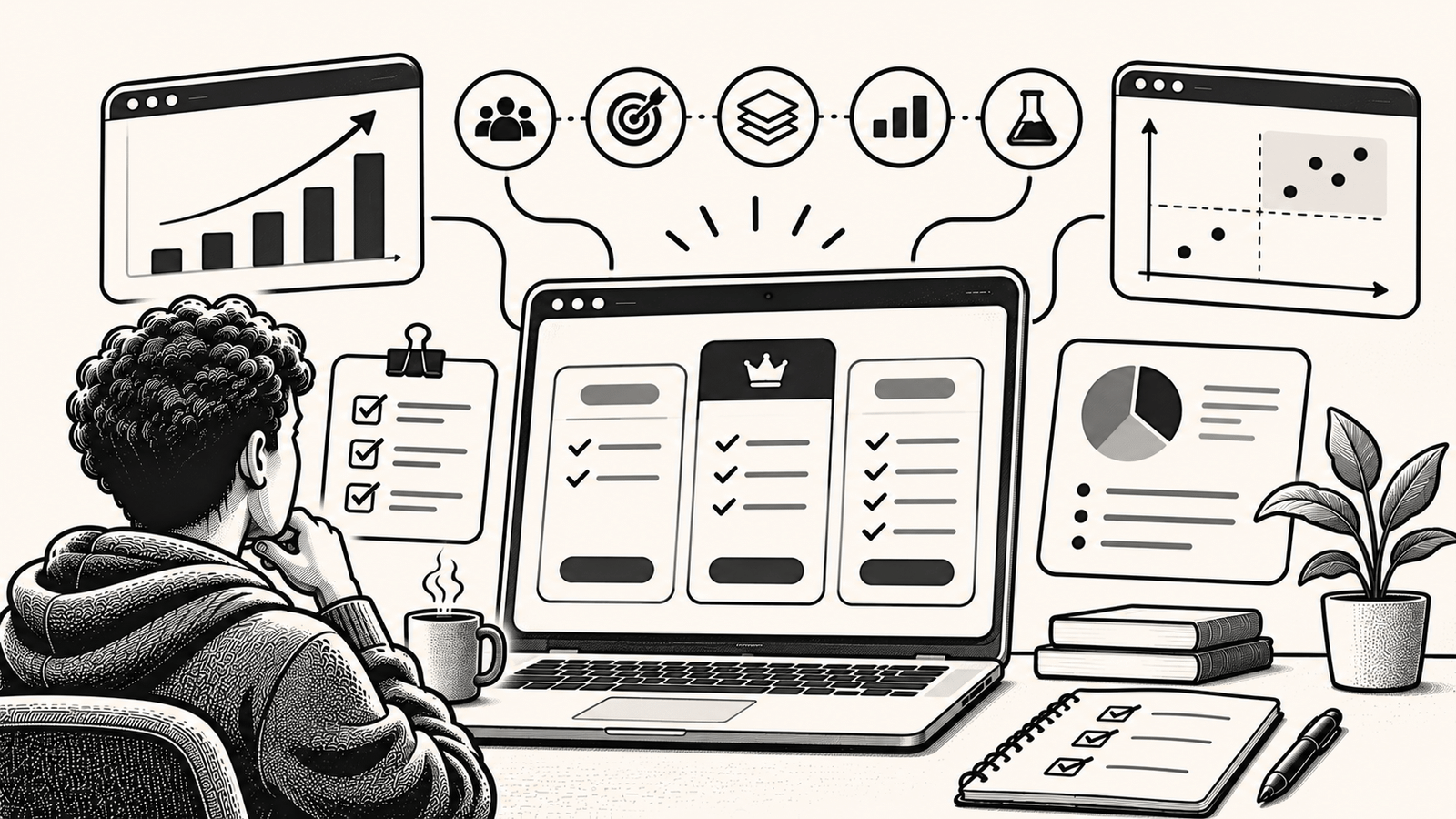
A simple structure might look like this:
| Plan | Intended customer | Packaging direction |
|---|---|---|
| Starter | Individual or very small operation | Core workflow and modest usage |
| Growth | Small team with regular usage | More capacity, collaboration and automation |
| Business | Larger or more demanding customer | Administration, advanced controls and support options |
This is an illustrative structure, not a recommendation that every SaaS product needs exactly three plans.
The important point is that each plan should make sense to a distinct customer type or usage pattern.
Give each plan a clear reason to exist
A buyer should be able to understand why one plan is different from another.
For example:
- Starter may help someone complete the primary job independently.
- Growth may support a team that needs shared workflows and higher limits.
- Business may support more complex administration, security or operational requirements.
Avoid placing a core feature behind a more expensive plan merely to force upgrades. A restriction should make sense in the context of a real customer segment or a meaningful increase in the value being delivered.
Make the upgrade path understandable
A customer should be able to predict what will make a higher plan useful.
That might be:
- More users joining the account.
- More projects or records being managed.
- Higher processing volume.
- A need for advanced reporting.
- A need for team administration or security controls.
If customers cannot understand why they would upgrade, your packaging may not reflect their actual needs.
Do not confuse free access with a pricing strategy
A free plan can help customers experience the product, but it also creates ongoing infrastructure and support costs.
Decide whether a free plan, free trial or paid-first model fits the product’s activation journey. The choice should follow how customers discover value, not a competitor’s default.
IndieOS covers this decision in Freemium vs. Free Trial.
6. Validate your price before making it permanent
You do not need to wait for hundreds of customers to learn something about pricing.
Start with a small research process.
Step 1: Interview people in your target segment
Speak with potential buyers who closely match your intended customer.
Focus on their current workflow, the problem’s consequences and what they would need to see before paying. Avoid turning the conversation into a pitch.
Step 2: Present a concrete offer
Describe the product, who it is for, what the customer receives and what it costs.
A real offer is more informative than asking someone whether an abstract idea sounds valuable.
Step 3: Compare a small number of options
You might test two packaging options or a small range of prices with prospective customers.
Keep the offer and audience as consistent as possible. Otherwise, you may not know whether the response changed because of the price, the feature set or the type of buyer.
Step 4: Observe actual purchase behaviour
Where practical, test an offer with new prospects and measure completed purchases rather than relying only on clicks or positive interview comments.
For low-traffic products, do not overinterpret tiny differences between price experiments. Use interviews, actual sales conversations and customer behaviour together.
Step 5: Document what you learned
Record the objections, reasons for purchase, requested features, price expectations and any differences between customer segments.
A pricing decision should have a reason behind it. Even when the data is limited, documenting the reasoning makes the next review more useful.
7. Measure more than the conversion rate
A higher price can reduce the number of people who buy while improving revenue per customer. A lower price can increase sign-ups while creating support or infrastructure costs that make the business harder to sustain.
That is why conversion rate alone is not enough.
Track several measures together:
| Metric | What it helps you understand |
|---|---|
| Visitor-to-paid conversion | Whether the offer turns relevant visitors into paying customers |
| Average revenue per account | How much recurring revenue an account generates |
| Gross margin by plan | Whether the plan is economically sustainable |
| Activation rate | Whether customers reach the product’s useful outcome |
| Churn by plan | Whether particular plans are associated with cancellations |
| Expansion revenue | Whether customers increase their spending as their needs grow |
| Refunds and discounts | Whether pricing or expectations may be creating friction |
| Support effort by plan | Whether higher-value plans also create disproportionate service work |
Look at these measures by customer segment and plan where the data allows it.
For example, a lower-priced plan might attract more customers but have weak activation. That could indicate an onboarding or customer-fit problem rather than simply a pricing problem. See SaaS onboarding best practices for ways to help new users reach value sooner.
Likewise, if customers cancel because they do not receive enough value, lowering the price may not solve the underlying issue. IndieOS also covers how to reduce churn in an early-stage SaaS.
A practical SaaS pricing worksheet
Before publishing your pricing page, complete this worksheet.
| Question | Your answer |
|---|---|
| Primary customer segment | Who is this plan designed for? |
| Main problem | What recurring problem does the product solve? |
| Current alternative | How does the customer solve it today? |
| Customer value | What time, cost, effort or risk does the product help reduce? |
| Value metric | What unit should the customer pay for? |
| Pricing model | Flat-rate, per-seat, tiered, usage-based or hybrid? |
| Cost floor | What does it cost to serve this customer? |
| Initial price range | What range will you validate? |
| Packaging | What does the customer receive at each level? |
| Upgrade trigger | What makes a higher plan useful? |
| Validation evidence | Which interviews, offers or purchases support the decision? |
| Review signals | Which metrics would tell you the price needs attention? |
If you cannot explain the value metric, the customer segment or the reason for each plan, keep researching before adding more complexity.
What should your SaaS pricing page explain?
Your pricing page is where the pricing strategy becomes a buying decision.
Make sure it answers the questions a potential customer is likely to have:
- Who is each plan intended for?
- What is included?
- Which usage limits apply?
- What happens when a limit is reached?
- Is billing monthly or annual?
- Is there a free trial or free plan?
- Can the customer cancel or change plans?
- Are there extra charges or paid add-ons?
Use plain language for limits and billing terms. A customer should not have to contact support to discover what a plan actually costs.
The page should also make the next step clear. That might be starting a trial, creating an account, booking a demo or purchasing immediately.
For the broader page structure and conversion experience, read SaaS landing page conversion rate.
Common SaaS pricing mistakes to avoid
Copying a competitor’s price without understanding its customers. A competitor’s price is context, not proof that the same price will work for your product.
Choosing a value metric that customers do not understand. A complicated billing unit can make an otherwise useful product harder to evaluate.
Offering too many plans too early. More options can make the buying decision harder and create extra work maintaining the pricing structure.
Using discounts to compensate for unclear value. A lower price may not fix a product that does not solve an important problem.
Making usage costs unpredictable. Usage-based pricing needs transparent limits and a way for customers to monitor consumption.
Changing prices without explaining the change. Existing customers should receive clear communication about what is changing, when it takes effect and how it affects their accounts.
Judging success by sign-ups alone. Revenue, margin, activation, retention and support effort all matter.
Frequently asked questions
How many pricing plans should a SaaS product have?
There is no fixed number that works for every product. Start with the smallest number of plans needed to serve distinct customer needs. Add another plan only when you can explain who it is for and why its packaging is different.
Should an early-stage SaaS product show its price publicly?
For a self-serve product with a clear package, publishing prices can make evaluation easier. Products that require custom implementation, negotiation or complex enterprise requirements may need a different approach. The decision should match how customers buy.
Should I use value-based pricing or cost-plus pricing?
Cost analysis helps you understand whether a price can support the business. Value-based thinking helps you understand what the customer receives and why the product is worth paying for. Use both perspectives rather than relying on either one alone.
Is usage-based pricing better for SaaS?
Not automatically. It can work when consumption closely reflects customer value and costs. It can also make bills harder to predict. A flat or hybrid model may be more suitable when customers need predictable recurring costs.
When should I change my SaaS pricing?
Review pricing when your customer segment, product capabilities, cost structure, usage patterns or market position changes. Also pay attention to repeated objections, weak upgrades, unexpected usage costs and differences in churn between plans. Do not change prices simply because a competitor has done so.
Final takeaway
A strong SaaS pricing strategy is not a clever number placed on a pricing page. It is a set of decisions about the customer you serve, the value you create, the unit you charge for and the way customers grow into higher-value plans.
Start with one customer segment. Identify a value metric that makes sense to that customer. Choose the simplest pricing model that fits the product. Build an initial price range from costs, alternatives and customer research. Then validate the offer through actual buying behaviour.
You do not need to get the price perfect on the first attempt. You need a clear reason for the price you choose, a way to observe how customers respond and a process for improving it as your product and customer base develop.